Proprietary Medicine Stamps

I recently became interested in private die proprietary medicine stamps as I have handled a lot of ephemera (billheads and letterheads) related to companies that issued these stamps. The stamps are colorful and the pull to start collecting the stamps is pulling at me hard. We'll see where it leads ;)

The U.S. imposed a medicine tax stamp on October 1, 1862 to raise revenue to meet the expenses of the Civil War. The U.S. government granted the privilege of preparing the private die stamps to firms who were willing to pay for the die charges. Approximately 277 companies issued their own private stamps prior to the repeal of the stamp tax on March 3, 1883. Here are some examples with accompanying

CENTAUR LINIMENT


G.G. Green


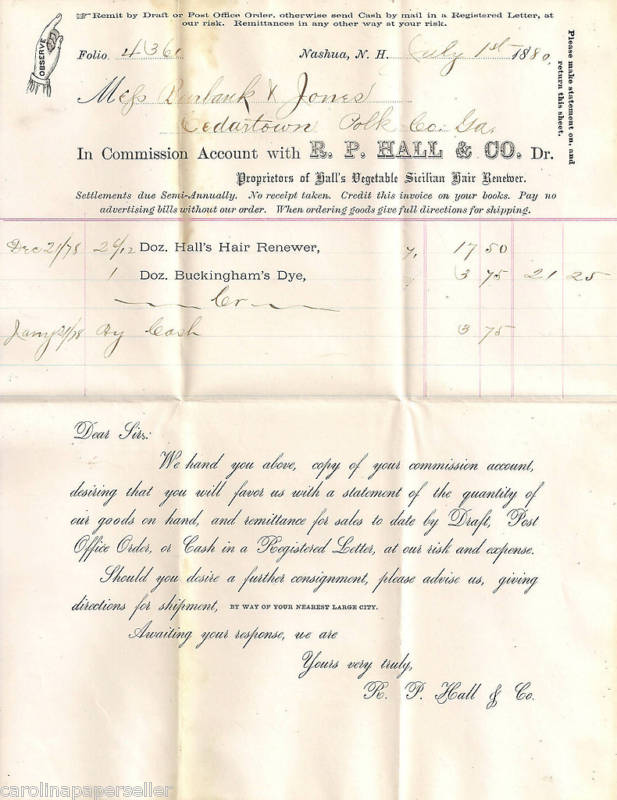
Reuben P. Hall


Dr. Harter


Dr. D. Jayne & Son


J.C. Ayer & Co.


John F. Henry & Co.


Rumford Chemical Works


A.B. Sands


Seabury & Johnson


S.R. Van Duzer


Weeks & Potter

Comments

Popular posts from this blog

Australian Billheads

As promised from by last post, here are some examples of Australian billheads I found on the website Print and Printmaking Australia Asia Pacific . Based on the Australian print collection at the National Gallery of Australia there is free online access to over 22,000 images. The databases can be searched by artist, subject or print techniques such as etching, woodcut, wood-engraving, linocut, lithograph, screenprint, monotype and other print related processes such as posters and artists books. Index to online information on printmakers, print workshops, print publishers, print galleries and public and private collections.

CAPEWELL HORSE NAIL COMPANY

I regularly purchase goods and paper at a local online auction. In December, I noticed that a lot of random estate / household goods also had a small pile of what looked to be calendars. I won the lot and sure enough it included many advertising calendars. Many of those were for the Capewell Horse Nail Company of Hartford Connecticut. These calendars were damaged, but the color and graphics were still very bright. Last week, I happened on a lot of paper through ebay that included a billhead for the company. Attached are photos of all for your enjoyment.

Rubber Goods

The rubber industry in the United States can hardly be said to have had any real and tangible existence until the discovery of the process of vulcanization in 1844 by Charles Goodyear. The first rubber ever imported into this country was brought into Boston in the year 1800 and came in In that same year a patent was granted to one Jacob Hummel, of Philadelphia, for a gum-elastic varnish; of which, however, there seems to have been no further mention. Some ten years later, in 1823, a Boston sea-captain, coming from South American ports, brought with him a pair of gilded rubber shoes which excited the greatest interest. Two years later, 500 pairs of rubber shoes, made by the natives along the Amazon, were brought into Boston, this time without the fantastical refinement of gilding. They were exceedingly thick, clumsy, and unshapely shoes, and yet they sold readily, bringing from $3 to $5 per pair as they were found that they were a secure protection against dampness. This was the e...